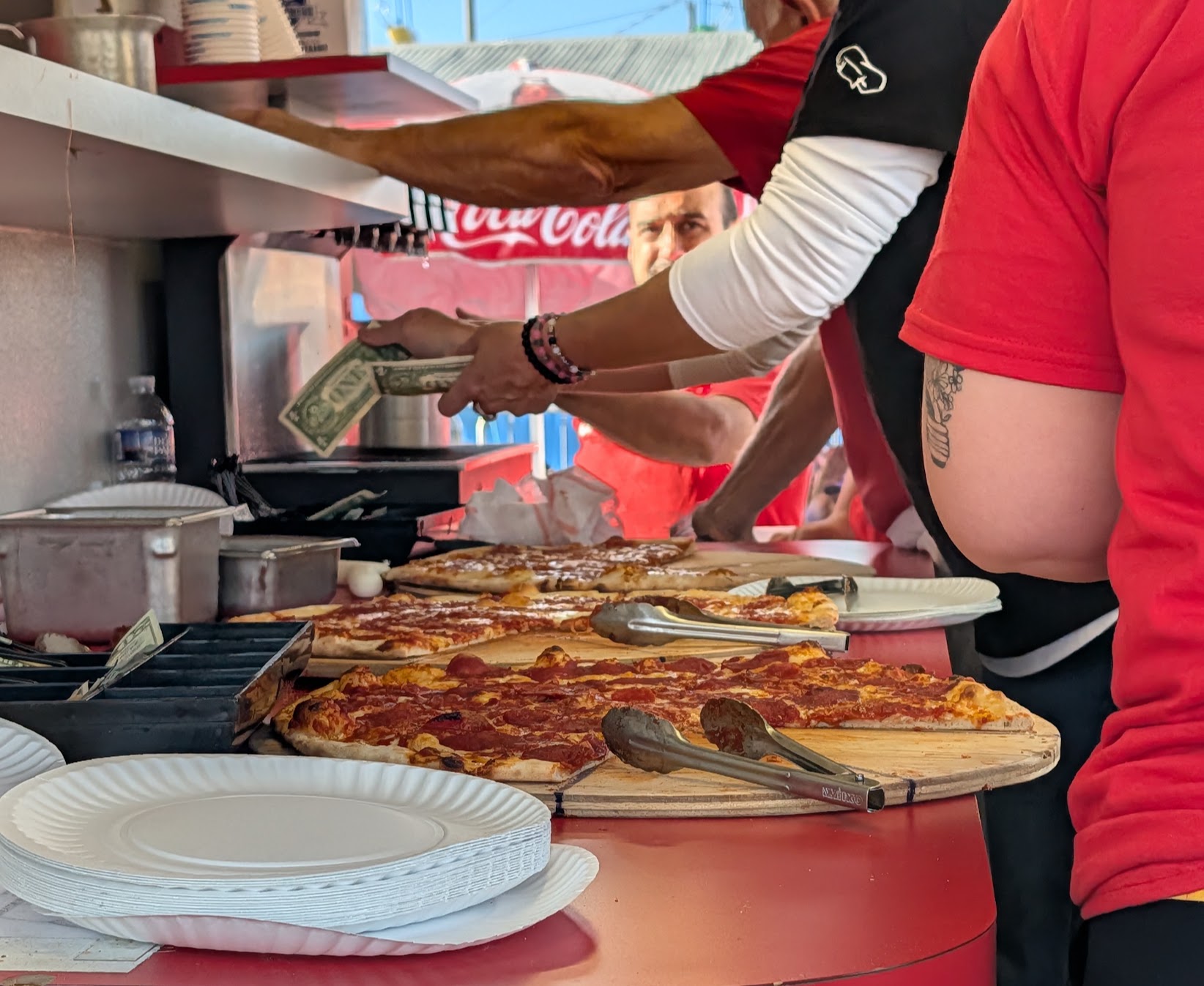
Cash changes hands at the Grotto Pizza stand on opening day. Grotto has grown into a regional brand with restaurants well beyond Bloomsburg, but the fair stand still draws a line on day one and that line will be constant for the next eight days. Photo by Skip Hidlay
What a century of family food stands at the Bloomsburg Fair can teach brands about connecting with customers
At 4 p.m. on a Friday, two hours after the gates opened for the annual Bloomsburg Fair’s preview day, the line at the Grotto Pizza stand was already 20 people deep.
I was in it. I grew up in Bloomsburg, a town in the rolling hills of northeastern Pennsylvania, where the last full week of September belongs less to the town than to the fair. The public schools close for the entire week, because so many families, and their kids, are working at the fair. Some run their own stands. Others pick up extra cash working someone else’s.
Welcome to the sights and sounds and smells of the 171st Bloomsburg Fair. It began in 1855 as a showcase for the fruits and grains of Columbia County farmers. Today more than 500,000 people pass through the gates over nine days, making it the largest fair in Pennsylvania.
Walking the grounds this year, I was struck less by what had changed than by what hadn’t. The same families run the same stands under the same signs, some so weathered they seem held together by paint and memory. Long before “food truck” and “pop-up” became part of American culture, Bloomsburg had its own version: a temporary city of family businesses that appears every September and is gone overnight a week later.
Many of these are family-built brands that exist nine days a year. And I’ve come to believe they understand building customer loyalty better than many companies operating 365 days a year.
Stand out, or get walked past
Look at it from the stand owner’s side. Half a million people. Hundreds of stands. A few seconds of attention as each fairgoer drifts past. No ad budget, no agency, no algorithm. Just a sign, and whatever you can put on it that makes a hungry stranger stop.
The answers are gloriously unpolished.


What unites these signs isn’t design. It’s conviction. Each one tells you exactly what you’ll get and who is making it. In a crowd of half a million, authenticity isn’t a style. It’s a strategy.
Earn it once a year
Standing out wins you one sale. Loyalty is harder when your customers see you nine days a year and spend the other 51 weeks without you.
The fair’s longtime stands earn it through ritual. Mine is vinegar on French fries, right out of the fryer. As a kid, I discovered that the Bowman’s and Gross’s French fry stands set out spray bottles of apple cider vinegar alongside the ketchup, and I’ve loved vinegar-doused fries ever since. It’s a tiny detail. Decades later, it’s still the reason I go looking for those stands.

Every Bloomsburg native carries a list of stands like mine that are must hits as you walk the fairgrounds. Fresh apple cider from Starr’s or the Benton Cider Mill. A warm dumpling under a scoop of ice cream. Kohr’s fresh-squeezed orangeade. Hewlett’s sausage and peppers. None of those memories is about a logo. Each is about a moment: a taste, a smell, a spritz of vinegar, a familiar face behind the counter.

A brand is the sum of every experience a person has with it. When you get only nine days a year, every one of those experiences must count.
Hand it down
Nowhere is that clearer than at Moyer’s Bar-B-Q.

“This is our 103rd year,” Wendy Keyser told me from behind the register. The stand comes from her mother’s side of the family, which started it in 1923.

Her son joined the business 20 years ago and now smokes all of the meats. The family still makes its own relish and barbecue sauce. “Everything’s homemade and we use local-sourced wood,” she says. When Moyer’s started, a sandwich cost 10 cents. Today it’s $10.

What Moyer’s doesn’t have is a restaurant. For more than a century, the brand has lived almost entirely inside those nine days. “It’s pretty much just the fair,” she said.
That’s the part of the Bloomsburg story I keep coming back to. The fair lets a family business become a multigenerational brand without ever becoming a big one. And the school week off isn’t just a vacation. It’s an apprenticeship. Kids learn the counter, the fryer and the regulars. Some of them grow up to run the stand.
Preserve the core, take it on the road
In their book Built to Last, Jim Collins and Jerry Porras found that enduring companies master a paradox: They hold fast to a core ideology while relentlessly pushing for progress. Preserve the core, stimulate progress.
The Bloomsburg Fair’s longest-running stands are a small, delicious proof of that idea. Moyer’s now has a food truck, taking a 103-year-old pop-up on the road. The relish, the smoke and the family behind the counter stay the same. What changes is how many days a year people can find them.
For leaders whose brands operate 365 days, the fair offers three questions worth asking:
- If your customers saw you only nine days a year, would they recognize you in a crowd?
- Would they line up on day one, without the ads and the reminders?
- Is your brand something your people would want to hand down?
I left the fairgrounds after a two-hour walkabout Friday, Sept. 23, with two Grotto pizza pies and a head full of old signs.
The fair ends this Saturday, Oct. 3, at 9 pm. The small city of big-top tents, food stands, carnival rides and games of chance will disappear overnight, as if it were all just a magical dream.
Next September, the families will be back, the signs will go back up and the line will start forming the minute the gates open.
That isn’t nostalgia. It’s a brand promise, kept one year at a time.