W. Clair Communications


  • An AI Insight Changes My Thinking

    An AI Insight Changes My Thinking

    The skyline of downtown Chicago reflected in the iconic sculpture “Cloudgate,” better known by local residents and tourists as “the Bean.” Appropriately, clouds swirl over the skyscrapers and are reflected in the sculpture. To me, Cloudgate resembles an elongated crystal ball and symbolizes a future of creativity and innovation. Photo by Skip Hidlay

    Using AI to amplify and optimize a team’s work.

    My epiphany about AI came in June 2024, near the end of a conference session for senior leaders.

    “If you take nothing else away from today, please accept that AI is here, it’s growing and it’s here to stay. It’s not going away,” the presenter said.

    “You owe it to yourself to learn how to use AI, and you owe it to your teams to help them upskill to learn how to use AI as part of their jobs. Why? Because AI isn’t going to take anybody’s job. But in the future, people who know how to use AI are going to take the jobs of people who don’t.”

    Until that moment, I had been in denial. That spring, the headlines about generative AI were foreboding. The stories often focused on the thousands upon thousands of jobs that could vanish as the powerful new technology was deployed to increase efficiencies — and profits — in many industries, particularly service industries.

    They gave me a sense of déjà vu dread. I had watched a new technology — the internet — hollow out newsrooms starting in the Great Recession of 2007-2009, wiping out thousands of journalism jobs and prompting me to pivot my career into health care marketing and communications.

    Rather than increasing my anxiety, the presenter’s challenge inspired me to act. Instead of living in denial, I walked out with a new leadership focus: stop worrying about what AI might do to our jobs and start helping my team learn to use AI and figure out how it could enhance our work.

    Half Right

    Two years later, the presenter’s view of the future looks half right.

    People who know how to use AI are pulling ahead in their careers. But leading CEOs, including those at Ford, Amazon, Salesforce and JPMorgan Chase, have said publicly that many white-collar jobs at their companies will soon disappear because of AI-powered efficiencies.

    Hiring of younger workers has slowed in the occupations most exposed to AI. Many leaders are using AI to do the same work with fewer people.

    I won’t pretend that course never makes financial sense, but new evidence suggests it may not be the right strategy. A 2026 survey by the enterprise AI company Writer found that 97% of executives say their companies deployed AI agents in the past year, yet only 29% report significant return on their generative AI investments. The gap between those two numbers isn’t a technology problem. It’s a leadership problem.

    Starting With Permission

    We began our AI journey in July 2024 with my marketing and communications team at the Ohio State Wexner Medical Center. Every team member went through basic AI training. We gave them access to AI tools and encouraged them to experiment. We began launching pilot projects to see how we could use AI to take over repetitive, routine tasks, such as resizing photos and ads, and give time back to team members to use for more complex, creative projects.

    The skyline of Chicago as evening falls with clouds swirling above the Hancock tower, the Bloomingdale's building and the new One Chicago skyscraper.
    The skyline of Chicago as evening falls with clouds swirling above the Hancock tower, the Bloomingdale’s building and the new One Chicago skyscraper. As we think about a future dominated by Generative AI, the horizon can seem cloudy and the path forward difficult to chart. But leaders owe it to themselves and their teams to jump in and make AI part of our how their daily work together. Photo by Skip Hidlay

    Progress wasn’t instantaneous. It took time for people to adjust to a new way of working and thinking — to begin using AI as a strategic thought partner, albeit a super-smart junior one that needed oversight and management.

    Through 2025 and into 2026, our AI experiments and pilot projects began to compound. By the time I left in March, the team had built a set of AI agents that changed what we were capable of. A few examples:

    Physician bios: Profiles for the health system’s Find a Doctor and Find a Researcher platforms used to move from writer to proofreader to marketing manager to the digital team and back again — a process that often took up to two months. Now an agent drafts the bio, a proofreader refines it and the digital team handles approval and publishing. The first projects finished in under 10 days.

    UX research: The user experience team loaded an agent with patient-experience survey data, national hospital benchmarks, website heat maps and usability best practices, then primed it to think like a UX researcher. It helped design a user test and then helped analyze the results, surfacing pain points and user motivations the team could act on.

    Brand compliance: One of the biggest time consumers for any marketing team is brand review, ensuring that every creative asset meets brand standards for design and style. Now, the brand compliance agent draws on the team’s AP style guide, voice-and-tone guidelines and naming standards to rapidly review Word documents, PDFs and images, so everything passing through the team stays on brand.

    Safety reports: Midyear and annual safety updates keep leadership informed, but compiling them steals time from the people doing the work. Microsoft Copilot and Google Gemini now draft a snapshot from communication plans and security screening data. The internal communications team reviews and refines instead of building from scratch.

    None of these agents replaced a person. Each one freed up time — hours, even days — for team members to focus on larger, more complex creative projects.

    Where Brand Actually Lives

    This matters beyond productivity because brands are built at the moments of contact between a person and an organization.

    A physician bio is one of those moments. For patients choosing a doctor, it’s often the first time they meet the person who will care for them. Getting accurate, well-written profiles published in 10 days instead of 60 doesn’t just clear a backlog. It gives consumers faster access to the information they need to make choices about their health care.

    Just as important, every hour AI agents saved my former team went back into the work only people can do: applying judgment, creativity and problem-solving to continue building Ohio State’s health care brand.

    The Choice

    Whether to use AI to enhance and optimize the work of existing teams or to eliminate jobs is a leadership choice.

    Every leader eventually will face that decision point. You can aim AI at reducing headcount, or you can use it to enhance and amplify your team members’ work.

    The technology works the same either way. What differs is the philosophy behind it and, over time, the type of organization you end up creating.

    I made my choice in July 2024. I’ve never regretted it.

  • Redesigning Seats on the Bus

    Redesigning Seats on the Bus

    Published in 2001, Jim Collins’ book Good to Great debunked key assumptions about how businesses become great and produce sustained excellent results. Collins and his research team found that factors like large acquisitions, revolutionary technology, and high executive compensation were accelerators, but not the root causes of greatness. Photo by Skip Hidlay

    Making the Leap from Good to Great

    There’s one book I’ve read and reread several times in three decades of leadership. Though it was published 25 years ago, it’s the first one I recommend when people ask me for business books they should read.

    For me, Good to Great has been a how-to guide on leading team transformations.

    Author Jim Collins and his research team spent five years comparing 1,435 companies to identify 11 worth studying to learn why — and how — some companies make the leap from good to great while others don’t.

    Collins introduced leadership transformation concepts in Good to Great that became timeless in the lexicon of business because he wove them into stories:

    The right people on the bus. The flywheel phenomenon. The hedgehog concept. The BHAG — the big hairy audacious goal. Level 5 leadership.

    “We expected that good-to-great leaders would begin by setting a new vision and strategy,” Collins wrote. “We found instead that they first got the right people on the bus, the wrong people off the bus, and the right people in the right seats — and then they figured out where to drive it.”

    Honoring Jim Collins’ work

    I want to both honor Collins’ work and share how I’ve applied his “first who, then what” framework in my practice to focus on redesigning the seats on the bus and identifying the best existing team members for these new seats.

    When I became The Ohio State University’s first enterprise Chief Communications and Marketing Officer for healthcare, I faced a daunting challenge: integrating three separate teams into one new department — a challenge made more complex because we were working remotely in the midst of the COVID pandemic.

    When taking over as a new leader, I have found an important initial step is to meet individually with each team member — no matter how long it takes or how busy you become.

    In these conversations, I ask each team member to share their personal career story, talk about the type of work that makes their soul sing — what they love to do — and provide their ideas for how to make our team better.

    Reading people rather than resumes

    This is the leadership discipline of human archaeology:

    As business conditions and strategic priorities change, talented team members are often filling roles that were designed for a previous version of the work, jobs that aren’t the best fit for their talent and that no longer advance the organization’s strategy.

    Human archaeology involves listening to learn, excavating team members’ experience, talent, and passion — and then matching their skills to new seats on the bus needed to advance enterprise goals.

    It requires reading people rather than resumes. And the courage to redesign the org chart around what you find.

    In my early days at Ohio State, one of the most revealing conversations I had was with Holly Roby. At the time, Holly was serving in an important role as marketing manager for Heart and Vascular services.

    When we talked, I learned she had previously served as creative director for a marketing agency, had a degree in journalism, and loved the creative process. As we began working together on projects, I also quickly learned that she was one of our best writers and editors.

    Crafting a new organizational design

    When I unveiled the new organizational design for the integrated Marketing, Communications and Digital Strategy Department, Holly held a leadership role in brand storytelling that previously didn’t exist — a new seat on the bus that would be critical to our future success.

    Since Holly had not worked previously in a traditional communications role, I received a healthy dose of skepticism from the team’s writers and editors, many of them seasoned journalists.

    A marketer? What does a marketer know about communications and storytelling?

    Give her a chance, I said, and you’ll see.

    Over the next five years, Holly became the linchpin in building the best multimedia brand storytelling team I’ve ever worked with in my career.

    She served as the editor of Ohio State Health & Discovery, bringing to life the new website we created to achieve the strategic imperative of building Ohio State’s brand as a destination for innovative clinical care and breakthrough scientific discovery.

    When I announced my plans to retire from Ohio State and start my own brand strategy practice, Holly shared how our work together changed her life.

    “I wanted to reach out to personally thank you for the lasting impact you’ve made on my career, my profession and me, personally,” she wrote. “You took a chance on me five years ago — putting me in a new position, giving me a team, and a whole new platform to develop.

    “I am so grateful that you saw something in me and gave me the confidence to rise to the challenge. Thank you for having faith in me and seeing potential in me that I didn’t see in myself.”

  • People Own What They Help Create

    People Own What They Help Create

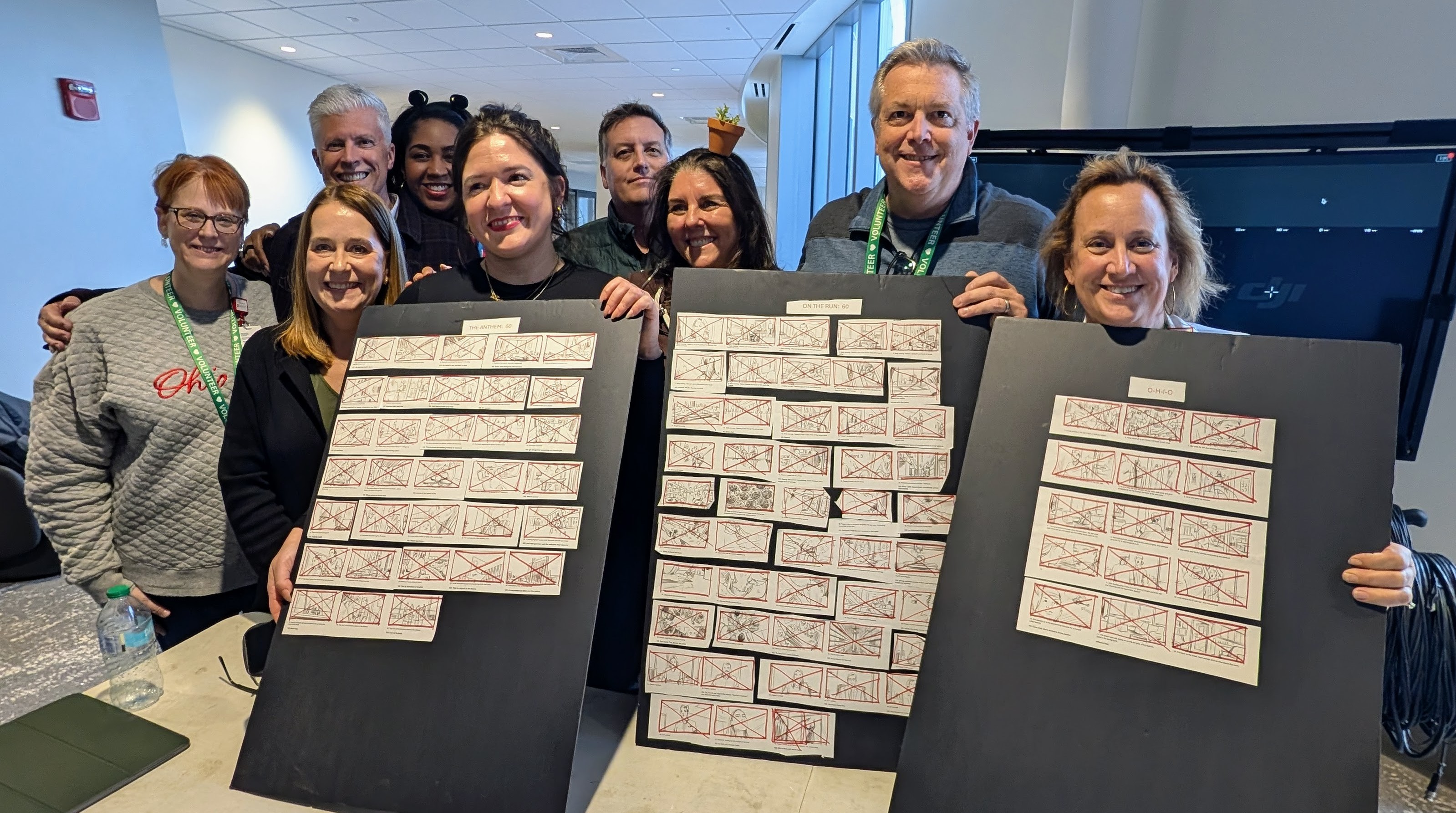
    Our team from The Ohio State University health system celebrates finishing a seven-day brand marketing shoot with colleagues from The Shipyard agency. We’d spent months collaborating with The Shipyard on new brand creative and filmed more than 90 individual scenes for multiple TV spots to launch the campaign. Photo by Skip Hidlay.

    A Playbook for Building Team Culture

    During a wide-ranging pitch for our business, a marketing agency strategist riffed on the power of genuine collaboration between team members to drive the iterative process of developing new brand campaigns.

    “People own what they help create,” said Mandi Cohen, head of strategy for The Shipyard.

    I nodded and smiled. I immediately wrote her quote on a scrap of paper so I would remember it exactly. She had distilled my experience to six simple words.

    Over three decades in leadership roles, I have learned that creating ownership is an essential ingredient in building high-performing teams.

    How you begin when taking over a new team sends a critical first signal about your views on ownership, what you value and how you will behave.

    Why Do Most Value Statements Fail?

    An important early step in creating ownership as a core pillar in your new team’s culture is the difficult, time-consuming and often-messy work of developing shared values.

    We’ve all heard the phrase “values-driven leadership” so often it’s become a corporate cliché. Many groan and roll their eyes when they hear this phrase.

    That’s because many leaders and organizations give lip service to values. They write them down, publish them on their websites, and then ignore them in how they behave and make decisions.

    Edgar Schein, who shaped the field of organizational culture, distinguished espoused values — what we say we believe — from underlying assumptions — what the culture actually rewards and punishes.

    If you’re not prepared to live by and uphold the values you develop, you will erode trust in your leadership and quickly lose credibility with your new team.

    How Do You Create Shared Values That Stick?

    I’ve helped communications and marketing teams develop shared values at three different health systems — two complex academic medical centers and a faith-based system that’s now part of Ascension.

    Each time, our team grew closer from the experience. Not because we discovered a magical combination of words to capture our values on paper. But because we took the time to follow an inclusive, collaborative process.

    Together.

    People own what they help create.

    When values are handed down from above — laminated, distributed, announced — they quickly fade into the background. When values are built by the people who are asked to live by them, something different happens.

    When I became the first enterprise-wide Chief Communications and Marketing Officer for The Ohio State University health system in November 2020, my charge — and challenge — was to integrate three separate and distinct teams with different cultures and practices into one unified department.

    As a first step in bringing the teams together, I knew instinctively that developing shared values would be critical — and that the process of doing it openly with broad-based input from team members would be as important as the final words.

    I enlisted the help of three staff members widely regarded as among the best writers and editors — one from each of the three teams. I gave them full rein to develop an initial draft, lead department-wide collaboration sessions, and create the final values we would commit to.

    They went off and worked for weeks. They argued over wording. They rejected the easy abstractions. They insisted on the specifics that mattered to them. They led meetings with other team members to get their input and feedback.

    They refined. They rewrote. They polished.

    When we unveiled the final wording, I committed publicly to live by our new shared values. I encouraged the department to hold me accountable.

    The values gradually became ingrained into our team’s culture and grew stronger with each year. They truly became our North Star.

    They stuck, I believe, because we took the time to debate, to disagree, and to listen to each other.

    This deliberative process created shared ownership of our new values.

    Values Are Behaviors, Not Abstractions

    Distilled to their essence, the shared values we developed at Ohio State were similar at each of the teams I have led in healthcare and the news media:

    • Maintaining a positive attitude.
    • Building ownership through teamwork and collaboration.
    • Committing to excellence through continuous improvement.
    • Assuming positive intent and extending grace when mistakes happen.

    Notice what these values are not. They are not abstract nouns dressed up to look strategic. They are behaviors.

    Assuming positive intent is something we can do or fail to do, in real time, on a Tuesday afternoon when a colleague’s email lands the wrong way. Extending grace is the choice we make when a teammate has gotten something wrong.

    A fair question: if our teams all built strong cultures, was it really the values exercise that did the work — or were we, as leaders, modeling the behavior all along, and our teams converged on values that matched our leadership styles?

    The honest answer is most likely both.

    A leader’s behavior fertilizes the soil. The team’s shared values grow — and a new culture begins to take shape — from the collaborative process.

    People own what they help create.