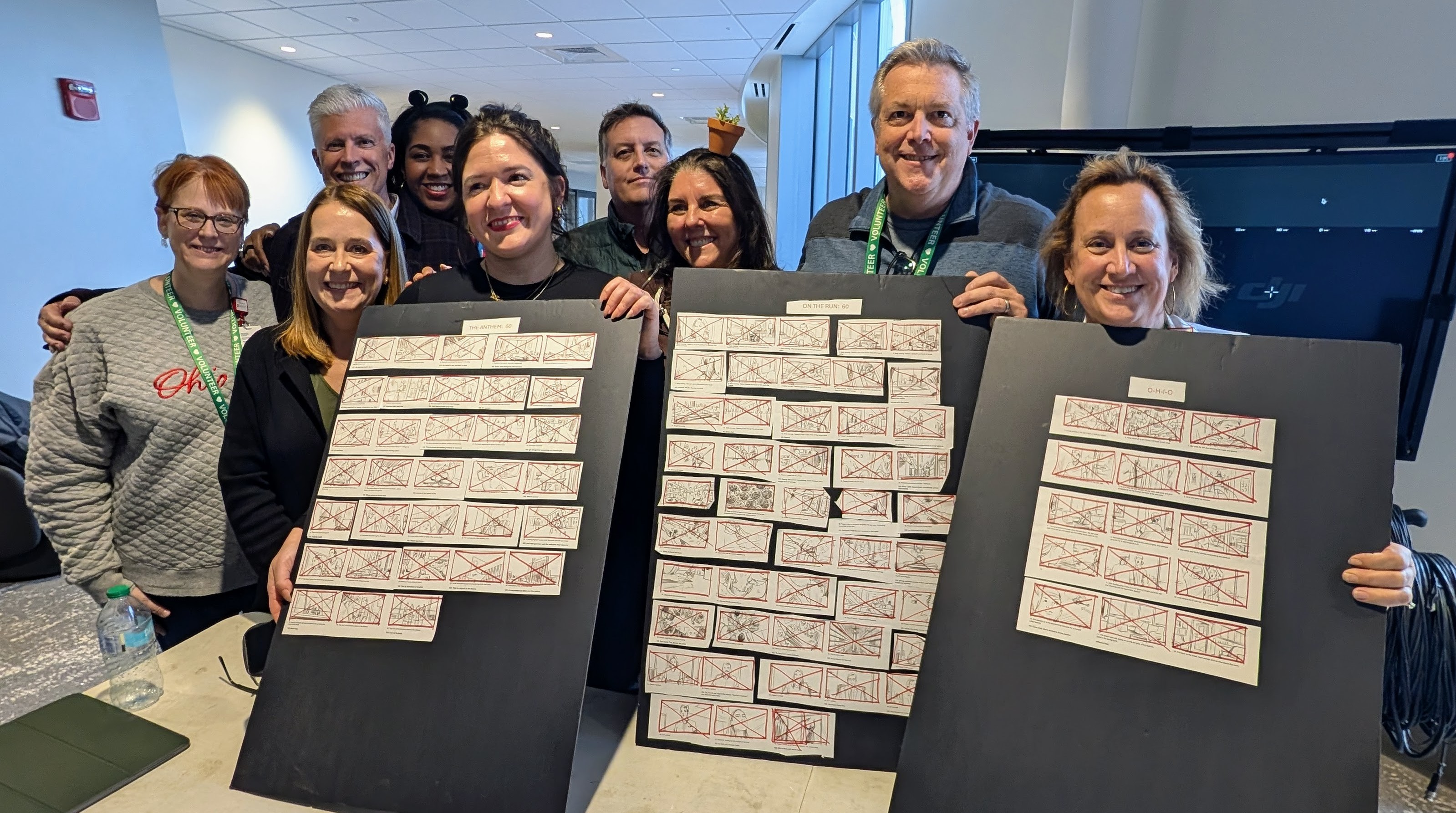
Our team from The Ohio State University health system celebrates finishing a seven-day brand marketing shoot with colleagues from The Shipyard agency. We’d spent months collaborating with The Shipyard on new brand creative and filmed more than 90 individual scenes for multiple TV spots to launch the campaign. Photo by Skip Hidlay.
A Playbook for Building Team Culture
During a wide-ranging pitch for our business, a marketing agency strategist riffed on the power of genuine collaboration between team members to drive the iterative process of developing new brand campaigns.
“People own what they help create,” said Mandi Cohen, head of strategy for The Shipyard.
I nodded and smiled. I immediately wrote her quote on a scrap of paper so I would remember it exactly. She had distilled my experience to six simple words.
Over three decades in leadership roles, I have learned that creating ownership is an essential ingredient in building high-performing teams.
How you begin when taking over a new team sends a critical first signal about your views on ownership, what you value and how you will behave.
Why Do Most Value Statements Fail?
An important early step in creating ownership as a core pillar in your new team’s culture is the difficult, time-consuming and often-messy work of developing shared values.
We’ve all heard the phrase “values-driven leadership” so often it’s become a corporate cliché. Many groan and roll their eyes when they hear this phrase.
That’s because many leaders and organizations give lip service to values. They write them down, publish them on their websites, and then ignore them in how they behave and make decisions.
Edgar Schein, who shaped the field of organizational culture, distinguished espoused values — what we say we believe — from underlying assumptions — what the culture actually rewards and punishes.
If you’re not prepared to live by and uphold the values you develop, you will erode trust in your leadership and quickly lose credibility with your new team.
How Do You Create Shared Values That Stick?
I’ve helped communications and marketing teams develop shared values at three different health systems — two complex academic medical centers and a faith-based system that’s now part of Ascension.
Each time, our team grew closer from the experience. Not because we discovered a magical combination of words to capture our values on paper. But because we took the time to follow an inclusive, collaborative process.
Together.
People own what they help create.
When values are handed down from above — laminated, distributed, announced — they quickly fade into the background. When values are built by the people who are asked to live by them, something different happens.
When I became the first enterprise-wide Chief Communications and Marketing Officer for The Ohio State University health system in November 2020, my charge — and challenge — was to integrate three separate and distinct teams with different cultures and practices into one unified department.
As a first step in bringing the teams together, I knew instinctively that developing shared values would be critical — and that the process of doing it openly with broad-based input from team members would be as important as the final words.
I enlisted the help of three staff members widely regarded as among the best writers and editors — one from each of the three teams. I gave them full rein to develop an initial draft, lead department-wide collaboration sessions, and create the final values we would commit to.
They went off and worked for weeks. They argued over wording. They rejected the easy abstractions. They insisted on the specifics that mattered to them. They led meetings with other team members to get their input and feedback.
They refined. They rewrote. They polished.
When we unveiled the final wording, I committed publicly to live by our new shared values. I encouraged the department to hold me accountable.
The values gradually became ingrained into our team’s culture and grew stronger with each year. They truly became our North Star.
They stuck, I believe, because we took the time to debate, to disagree, and to listen to each other.
This deliberative process created shared ownership of our new values.
Values Are Behaviors, Not Abstractions
Distilled to their essence, the shared values we developed at Ohio State were similar at each of the teams I have led in healthcare and the news media:
- Maintaining a positive attitude.
- Building ownership through teamwork and collaboration.
- Committing to excellence through continuous improvement.
- Assuming positive intent and extending grace when mistakes happen.
Notice what these values are not. They are not abstract nouns dressed up to look strategic. They are behaviors.
Assuming positive intent is something we can do or fail to do, in real time, on a Tuesday afternoon when a colleague’s email lands the wrong way. Extending grace is the choice we make when a teammate has gotten something wrong.
A fair question: if our teams all built strong cultures, was it really the values exercise that did the work — or were we, as leaders, modeling the behavior all along, and our teams converged on values that matched our leadership styles?
The honest answer is most likely both.
A leader’s behavior fertilizes the soil. The team’s shared values grow — and a new culture begins to take shape — from the collaborative process.
People own what they help create.